Posts

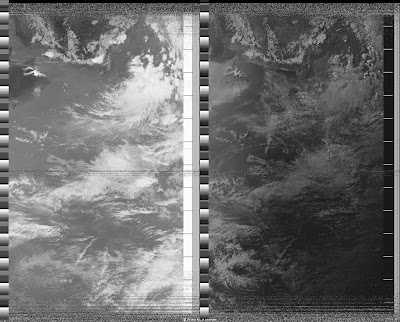
Receiving NOAA weather images using RTL-SDR
Image
HI all , In one of my previous posts , I explained how to receive ISS SSTV images (see  RECEIVING SSTV FROM ISS ! Steps involved in decoding when using MMSSTV ).Today I will describe reception of APT images from NOAA series of satellites using RTL-SDR dongles . The steps are outlined below . Record the WBFM signals from one of the NOAA weather sats ( NOAA 15,18 or 19) . You can use any of the satellite prediction software like Orbitron,GPredict etc to do the predictions . The recording can be done using any the SDR software like SDRsharp , HDSDR or GQRX . I use GQRX as my lab PC is Linux powered (see  Lab / Shack PC running Linux !  ) . The recording should be in .WAV format with the filter set tot the right bandwidth . Import the .WAV file into Audacity . Change the project rate to 11025 Hz and split the stereo track into two ( If u don't know audacity , this can be done by clicking the small arrow button near the tracks ) . Delete one of the tracks and make t...

Jottings on HEXFET power amplifiers

Image
Hi all, HEXFETs are quite popular with hams as HF linear stages . I too attempted to make some linear amps with them and that too with pretty promising results . Here is the outcome . The first FET that I tried was a IRF540 . The circuit used is given below . I had to place some component in TINA as a choke , so I put a 1m choke . In reality , I used a torroid with some 20 winding . I could pull some 2~3W into a 50 ohm dummy load ( which I used as a termination in front of the CRO ) at 1MHz , but at higher freq , power output dropped drastically . The power calculation was carried on the basis of the voltage that I measured across 50 ohm load . The voltage peak to peak was 40V . So that gives me around 2W power . Next , I'm gonna try IRF530 , IRF610 etc  

Some thoughts on DDS VFOs

Image
Hello all ! I recently homebrewed a Direct Digital Synthesis Variable Frequency Oscillator (DDS VFO) . The reason for this was quite strong.Almost all the VFOs that I had attempted suffered from stability issues.Besides,it was impossible to know the frequency of oscillation precisely and accurately (with atleast 100Hz precision).It was then I came to notice the AD9850 DDS modules in ebay.They are cheap,easy to use,stable and have a large tuning range (from ~1Hz to 40Mhz) which makes them a good alternative to analog VFOs.On another note,VU2MV,OM Venu once commented " You need the grace of God to make a stable analog VFO !". The VFO design is simple.I use an Arduino as the controlling board. The frequency tuning is carried out using four push buttons,arranged in a navigation button style. The code for Arduino and the inside view of VFO shall be posted soon along with the ckt diagram. For the time being,I'm posting the pics of the completed VFO and the video of its smok...

RECEIVING SSTV FROM ISS ! Steps involved in decoding when using MMSSTV ......

Image
A very interesting mode in ham radio is SSTV and more interesting is the SSTV from ISS - the International Space Station ! Receiving the images from ISS is pretty simple . However many hams have some problems recording SSTV audio and decoding them using MMSSTV . My ham friends like OM Ramesh VU3RGB , OM Sulaiman VU3SMQ and OM Dhanesh VU3DHN encouraged me to make a blog post describing the various steps involved . 1) The first step is simple . Just tune to 145.800MHz in your VHF receiver and record the audio using some device like your smartphone,holding it near to your rig .It is better to use SDRs like RTLSDR to record audio using a computer. However my shack PC is QRT now , so ,I can't use SDR . Anyway be sure to use some excellent satellite tracking software like the Hamsatdroid (Android) or Orbitron (Windows) to guide you in tracking the ISS . 2) After recording , copy the recorded .amr file to your PC from phone . Use some tool to convert the amr to wav file . One excellen...

Some experiments with Doubler Variable Frequency Oscillators (VFO)

Image
Getting into HF is easy and challenging simultaneously for modern homebrewers ! The difficulty lies with the fact that almost all modern ham HF QSOs occur in SSB and homebrewing SSB rigs is a bit tricky . However it is easy to get a large amount of resource from internet regarding the various transceiver circuits , test gigs etc . 40m (7MHz)  is a ham band that is still very active . However all my attempts to make a rig for this band failed due to VFO problems. Browsing the web one of the circuits that grabbed my attention is an old one - Doubler VFO by VU2ITI - OM Mani .( See here  www.qsl.net/vu2msy/homebrew/Ceramic_Resonator_VFO_VU2ITI.pdf )   It a great circuit and the concept is beautiful . Make a ~3.5MHz sine wave , use a multiplier (a nonlinear circuit) , get a 7Mhz output ( and perhaps some undesired harmonics Thanks to OM Joseph Fourier , HI !) . This sounded  beautiful as 3.58MHz ceramic resonators are available in plenty  in my hometown ( Payy...