Posts

Using FTDI USB to serial converter in Linux - Ubuntu

I recently purchased an FTDI USB to serial converter - FT232RL. However I could not use it properly in Windows. With some googling, I could find a way to use it under linux. Following are the steps to be used in Ubuntu to get it working. Open a terminal and type the following commands. sudo modprobe ftdi_sio sudo chmod 666 /sys/bus/usb-serial/drivers/ftdi_sio/new_id nano /sys/bus/usb-serial/drivers/ftdi_sio/new_id In the file that got opened, type 0403 8a8a and save it. The number can be found by typing lsusb in another terminal. Now unplug and re-plug the module. Type  ls /dev and you should see /ttyUSB0 in the list. Now use some serial terminal (like screen) to view the data ! For opening a screen session, the following command is used. Here 115200 is the baud rate. sudo screen /dev/ttyUSB0 115200
A simple guide to installing and using RTL-SDR and related software in Ubuntu

Image
Hello all ! In this post , let me help you install and use RTL-SDR and related software in Linux , specifically Ubuntu . The software being installed are  GNUradio and GQRX . GQRX I have tried this procedure in several systems running Ubuntu 14.04 LTS as well as Mint OS ( which is based on Ubuntu ) . The procedure assumes that you have access to root password and knows basics of Linux terminal. Moreover you need a working internet connection. If you don't know how to use the terminal , then please watch some youtube videos on the same . So let's start ! Step 0 Install Ubuntu ! This is the right decision that you can make . Linux is ideal for developers and hackers ( I mean hackers like Richard Stallman and not crackers ) . Step 1 Open a linux terminal ( Ctrl+Alt+T) and type the following command sudo apt-get update You will be prompted for the password . Give it . It won't be shown on the screen . This will update your Ubuntu installation and install th...

Some experiments with double balanced mixers and GNURadio

Image
Hi all, This post is all about frequency mixing , specifically double balanced mixers using diodes or ring mixers , commonly used in communication circuits . The circuit diagram of a ring mixer is given below . (Courtesy : Radio-electronics  ) Schematic of a double balanced mixer.  As you can see , this makes use of two transformers and a four diodes . For most of the HF work , switching diodes like 1N4148 suffice . However , for better performance Schottky diodes like 1N5711 can be made use of . For more information on the working of this mixer and construction aspects , I strongly recommend the excellent video by W2AEW on ring mixers given below .  So what I wish to explain in this video is a set of experiments carried out using a double balanced mixer which I shall call DB mixer for convenience :) The test gear consists of a DDS VFO , a crystal Colpitts oscillator , a variable  power supply , CRO , RTL-SDR and the PC sound card . The software tool...

The trouble with double balanced mixers

Hello folks ! I never knew that overdriving double balanced mixers can actually reduce their very purpose of carrier suppression . I found this out while watching a video on microwave mixers . This problem was plaguing my Bitx40 , one of the reasons why I didn't put a linear stage on it and come on air . Instead of using its own LC VFO , I use a DDS VFO external to the Bitx40 . It had stupendous amount of carrier in its output . Trying to figure out the cause , I changed the diodes , rewound the transformers , but nothing worked out . However reducing the drive level alleviated the problem . After doing a few simulations of this in TINA-TI and obtaining the results , I did the same with the actual Bitx40 PCB . The CRO output looks much better now compared to the previous cases . The tests on a receiver too is encouraging as I can hear my sound as an SSB signal in it . Needless to say , the BFO stage has to be tuned to match the crystal filter's range to ensure best operation ...

Receiving NOAA weather images using RTL-SDR

Image
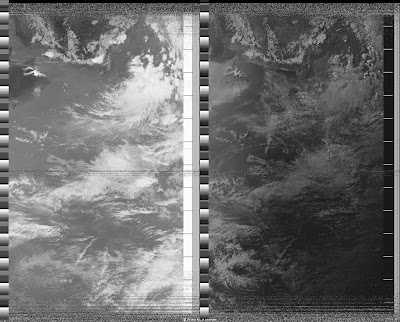
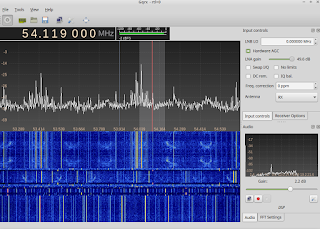
HI all , In one of my previous posts , I explained how to receive ISS SSTV images (see  RECEIVING SSTV FROM ISS ! Steps involved in decoding when using MMSSTV ).Today I will describe reception of APT images from NOAA series of satellites using RTL-SDR dongles . The steps are outlined below . Record the WBFM signals from one of the NOAA weather sats ( NOAA 15,18 or 19) . You can use any of the satellite prediction software like Orbitron,GPredict etc to do the predictions . The recording can be done using any the SDR software like SDRsharp , HDSDR or GQRX . I use GQRX as my lab PC is Linux powered (see  Lab / Shack PC running Linux !  ) . The recording should be in .WAV format with the filter set tot the right bandwidth . Import the .WAV file into Audacity . Change the project rate to 11025 Hz and split the stereo track into two ( If u don't know audacity , this can be done by clicking the small arrow button near the tracks ) . Delete one of the tracks and make t...

Jottings on HEXFET power amplifiers

Image
Hi all, HEXFETs are quite popular with hams as HF linear stages . I too attempted to make some linear amps with them and that too with pretty promising results . Here is the outcome . The first FET that I tried was a IRF540 . The circuit used is given below . I had to place some component in TINA as a choke , so I put a 1m choke . In reality , I used a torroid with some 20 winding . I could pull some 2~3W into a 50 ohm dummy load ( which I used as a termination in front of the CRO ) at 1MHz , but at higher freq , power output dropped drastically . The power calculation was carried on the basis of the voltage that I measured across 50 ohm load . The voltage peak to peak was 40V . So that gives me around 2W power . Next , I'm gonna try IRF530 , IRF610 etc  

Some thoughts on DDS VFOs

Image
Hello all ! I recently homebrewed a Direct Digital Synthesis Variable Frequency Oscillator (DDS VFO) . The reason for this was quite strong.Almost all the VFOs that I had attempted suffered from stability issues.Besides,it was impossible to know the frequency of oscillation precisely and accurately (with atleast 100Hz precision).It was then I came to notice the AD9850 DDS modules in ebay.They are cheap,easy to use,stable and have a large tuning range (from ~1Hz to 40Mhz) which makes them a good alternative to analog VFOs.On another note,VU2MV,OM Venu once commented " You need the grace of God to make a stable analog VFO !". The VFO design is simple.I use an Arduino as the controlling board. The frequency tuning is carried out using four push buttons,arranged in a navigation button style. The code for Arduino and the inside view of VFO shall be posted soon along with the ckt diagram. For the time being,I'm posting the pics of the completed VFO and the video of its smok...