Posts

Digital modes with VUSDR and Quisk

Image
Hello all, VUSDR is a popular TxRx SDR in India. Inspired by Peaberry SDR, it can also be used in Linux machines with Quisk as the software. In this post, I won't go into the details of configuring Quisk for normal SDR. Instead, assuming that it is already done, I shall go into the details of configuring it for digital modes especially configuring for WSJT-X for Ubuntu 16.04. As for normal Quisk configuration, I might blog about it in future. A word of caution ! These steps worked for me, but I cannot guarantee that they will work for you. So let's get started ! First download and install WSJTX from the following link. https://physics.princeton.edu/pulsar/k1jt/wsjtx.html You can double click and install the .deb file or can use terminal to install. I used the following command to install it (remember to open a terminal and navigate to the folder where the .deb file is present before typing this command) sudo apt install ./wsjtx_1.8.0_amd64.deb Next step is to in...
Using FTDI USB to serial converter in Linux - Ubuntu

I recently purchased an FTDI USB to serial converter - FT232RL. However I could not use it properly in Windows. With some googling, I could find a way to use it under linux. Following are the steps to be used in Ubuntu to get it working. Open a terminal and type the following commands. sudo modprobe ftdi_sio sudo chmod 666 /sys/bus/usb-serial/drivers/ftdi_sio/new_id nano /sys/bus/usb-serial/drivers/ftdi_sio/new_id In the file that got opened, type 0403 8a8a and save it. The number can be found by typing lsusb in another terminal. Now unplug and re-plug the module. Type  ls /dev and you should see /ttyUSB0 in the list. Now use some serial terminal (like screen) to view the data ! For opening a screen session, the following command is used. Here 115200 is the baud rate. sudo screen /dev/ttyUSB0 115200

A simple guide to installing and using RTL-SDR and related software in Ubuntu

Image
Hello all ! In this post , let me help you install and use RTL-SDR and related software in Linux , specifically Ubuntu . The software being installed are  GNUradio and GQRX . GQRX I have tried this procedure in several systems running Ubuntu 14.04 LTS as well as Mint OS ( which is based on Ubuntu ) . The procedure assumes that you have access to root password and knows basics of Linux terminal. Moreover you need a working internet connection. If you don't know how to use the terminal , then please watch some youtube videos on the same . So let's start ! Step 0 Install Ubuntu ! This is the right decision that you can make . Linux is ideal for developers and hackers ( I mean hackers like Richard Stallman and not crackers ) . Step 1 Open a linux terminal ( Ctrl+Alt+T) and type the following command sudo apt-get update You will be prompted for the password . Give it . It won't be shown on the screen . This will update your Ubuntu installation and install th...

Some experiments with double balanced mixers and GNURadio

Image
Hi all, This post is all about frequency mixing , specifically double balanced mixers using diodes or ring mixers , commonly used in communication circuits . The circuit diagram of a ring mixer is given below . (Courtesy : Radio-electronics  ) Schematic of a double balanced mixer.  As you can see , this makes use of two transformers and a four diodes . For most of the HF work , switching diodes like 1N4148 suffice . However , for better performance Schottky diodes like 1N5711 can be made use of . For more information on the working of this mixer and construction aspects , I strongly recommend the excellent video by W2AEW on ring mixers given below .  So what I wish to explain in this video is a set of experiments carried out using a double balanced mixer which I shall call DB mixer for convenience :) The test gear consists of a DDS VFO , a crystal Colpitts oscillator , a variable  power supply , CRO , RTL-SDR and the PC sound card . The software tool...

The trouble with double balanced mixers

Hello folks ! I never knew that overdriving double balanced mixers can actually reduce their very purpose of carrier suppression . I found this out while watching a video on microwave mixers . This problem was plaguing my Bitx40 , one of the reasons why I didn't put a linear stage on it and come on air . Instead of using its own LC VFO , I use a DDS VFO external to the Bitx40 . It had stupendous amount of carrier in its output . Trying to figure out the cause , I changed the diodes , rewound the transformers , but nothing worked out . However reducing the drive level alleviated the problem . After doing a few simulations of this in TINA-TI and obtaining the results , I did the same with the actual Bitx40 PCB . The CRO output looks much better now compared to the previous cases . The tests on a receiver too is encouraging as I can hear my sound as an SSB signal in it . Needless to say , the BFO stage has to be tuned to match the crystal filter's range to ensure best operation ...

Receiving NOAA weather images using RTL-SDR

Image
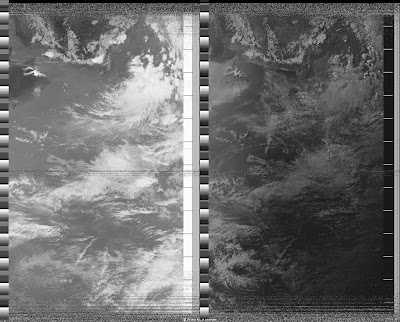
HI all , In one of my previous posts , I explained how to receive ISS SSTV images (see  RECEIVING SSTV FROM ISS ! Steps involved in decoding when using MMSSTV ).Today I will describe reception of APT images from NOAA series of satellites using RTL-SDR dongles . The steps are outlined below . Record the WBFM signals from one of the NOAA weather sats ( NOAA 15,18 or 19) . You can use any of the satellite prediction software like Orbitron,GPredict etc to do the predictions . The recording can be done using any the SDR software like SDRsharp , HDSDR or GQRX . I use GQRX as my lab PC is Linux powered (see  Lab / Shack PC running Linux !  ) . The recording should be in .WAV format with the filter set tot the right bandwidth . Import the .WAV file into Audacity . Change the project rate to 11025 Hz and split the stereo track into two ( If u don't know audacity , this can be done by clicking the small arrow button near the tracks ) . Delete one of the tracks and make t...

Jottings on HEXFET power amplifiers

Image
Hi all, HEXFETs are quite popular with hams as HF linear stages . I too attempted to make some linear amps with them and that too with pretty promising results . Here is the outcome . The first FET that I tried was a IRF540 . The circuit used is given below . I had to place some component in TINA as a choke , so I put a 1m choke . In reality , I used a torroid with some 20 winding . I could pull some 2~3W into a 50 ohm dummy load ( which I used as a termination in front of the CRO ) at 1MHz , but at higher freq , power output dropped drastically . The power calculation was carried on the basis of the voltage that I measured across 50 ohm load . The voltage peak to peak was 40V . So that gives me around 2W power . Next , I'm gonna try IRF530 , IRF610 etc